From Pixels to Systems: Practical Lessons from Generative Vision Research
Published:
Practical observations from work on image restoration, generative editing, efficient adaptation, assistive vision, and production machine learning systems.
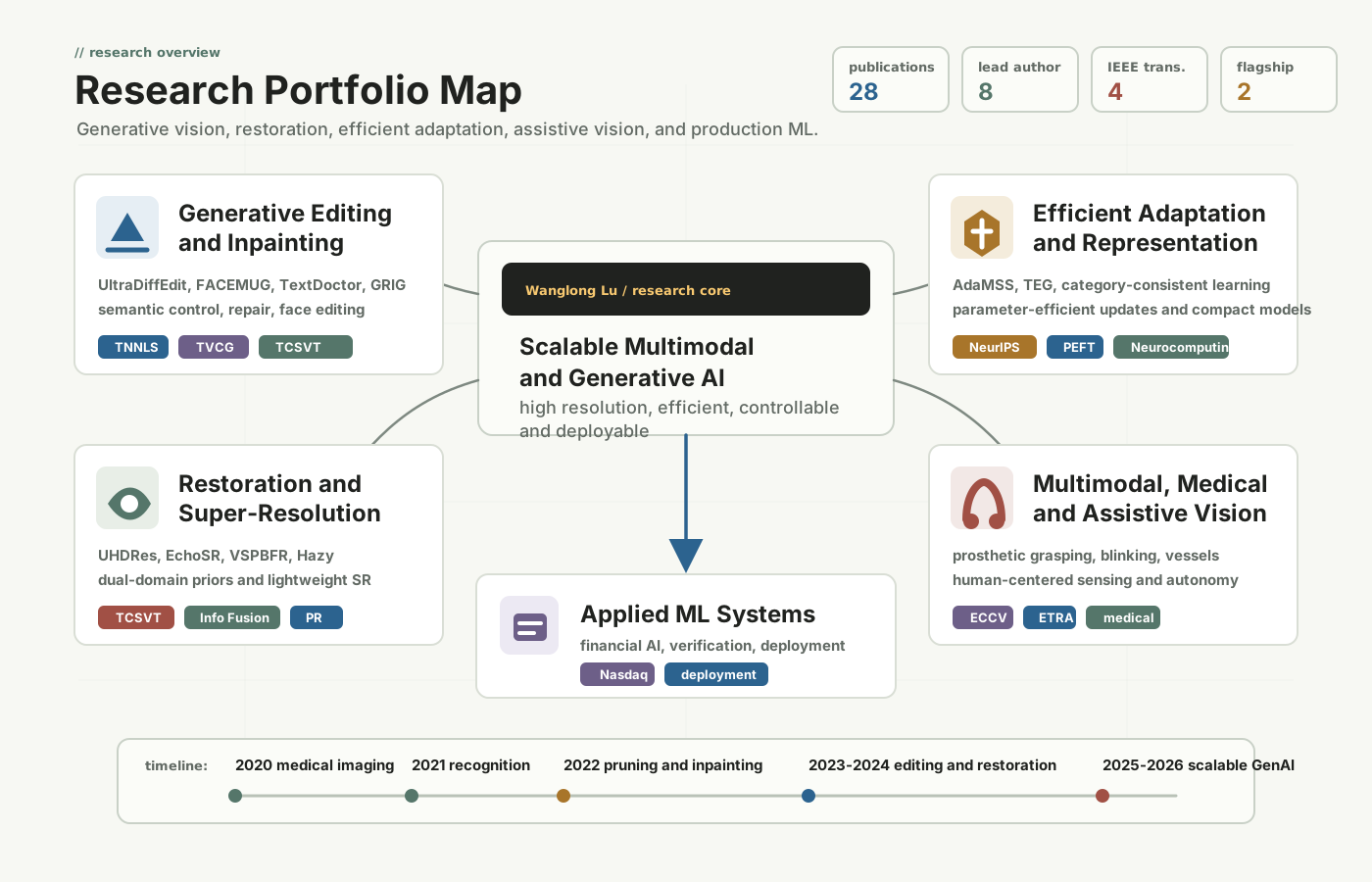
Computer vision systems often fail for reasons that are not captured by model size or benchmark accuracy. A restoration model may remove noise but also erase useful detail. An editing model may generate a plausible result while changing regions that should remain fixed. At high resolution, local processing may break global consistency. In production, a strong model may still be unsuitable because of memory, latency, data quality, or reliability constraints.
Across work in recognition, medical imaging, restoration, generative editing, efficient adaptation, assistive vision, and financial AI, four design questions appear repeatedly:
- What structure is already known about the task?
- What parts of the output must remain controlled?
- Where should computation be spent?
- How should the model be evaluated in the system where it will be used?
This article connects these questions to specific projects and summarizes the practical conclusions.
1. Many Vision Tasks Can Be Written as Inverse Problems
Many computer vision tasks can be written as a structured inverse problem:
\[y = \mathcal{H}(x) + \epsilon,\]where $x$ is the clean or desired signal, $y$ is the observation, $\mathcal{H}$ is a degradation, transformation, or sensing process, and $\epsilon$ is noise, uncertainty, or missing information.
This view is useful because it unifies tasks that appear unrelated:
- In image restoration, $\mathcal{H}$ may be blur, haze, low resolution, compression, or reflection.
- In inpainting, $\mathcal{H}$ is a masking operator.
- In semantic editing, $\mathcal{H}$ includes the constraints imposed by the original image and the edit instruction.
- In blink detection or prosthetic grasping, $\mathcal{H}$ is the partial observation process through cameras, simulation, or human-object interaction.
- In financial synthetic data generation, $\mathcal{H}$ includes privacy, distributional shift, temporal dependence, and heavy-tailed uncertainty.
The research question is therefore not just “can the model generate a plausible output?” It is:
\[\hat{x} = \arg\max_x p(x \mid y, c, \Pi),\]where $c$ is a control signal and $\Pi$ is a set of priors. The control signal may be an exemplar, a text prompt, a visual style prompt, a degradation representation, a frequency-domain constraint, a subspace update, or a simulation-derived policy. The prior may come from data, geometry, frequency statistics, pretraining, temporal continuity, or deployment constraints.
This formulation provides a common way to discuss restoration, editing, recognition, and decision systems.
2. Priors Matter More When Data Is Limited or Resolution Is High
Work on category-consistent vehicle logo recognition, retinal vessel segmentation, and probability-based channel pruning illustrates a basic point: when data or compute is limited, generic representation learning is often not enough.
In recognition, category consistency acts as a semantic regularizer. In vessel segmentation, a large receptive field helps capture thin and elongated anatomical structures. In pruning, probabilistic modeling provides a criterion for removing channels without treating all filters as equally replaceable. These methods use task-specific structure rather than relying only on model scale.
The same principle becomes even more important in generative vision. For GRIG, the key problem is not merely filling a hole; it is preserving identity, context, and residual structure with limited data. For FACEMUG, local facial editing requires multimodal control that changes the requested region while keeping the rest of the face stable. For TextDoctor, document image inpainting requires preserving readability and layout, not just visual realism.
A prior is useful when it reduces the ambiguity that matters for the task. A face prior should preserve identity. A document prior should preserve layout and text consistency. A restoration prior should preserve detail without adding unsupported content. A financial sequence prior should preserve temporal dependence and heavy-tailed behavior.
3. Control Matters as Much as Generation
Diffusion models learn a denoising or score function over a sequence of corrupted variables. A common forward process is:
\[x_t = \sqrt{\bar{\alpha}_t}x_0 + \sqrt{1-\bar{\alpha}_t}\epsilon,\]and a model estimates either the noise $\epsilon$, the clean signal $x_0$, or a score-like direction:
\[s_\theta(x_t, t, c) \approx \nabla_{x_t}\log p_t(x_t \mid c).\]This gives diffusion models a strong generative prior. In editing and restoration, however, the model must also preserve information from the input. Sampling quality alone is not enough; the sampling process must respect spatial and semantic constraints.
Tuning-Free Latent Diffusion Models for Ultrahigh-Resolution Image Editing addresses this issue for real-image editing without retraining. At 8K resolution, the system must preserve unedited regions, maintain the requested semantic change, and keep local texture consistent with the full image. Memory use and tiling artifacts are part of the method design, not only implementation details.
When the canvas becomes large, every local decision must remain compatible with a global structure. A model that works on a small crop may fail when the crop must align with the entire image.
4. Restoration Needs Both Signal Priors and System Efficiency
Image restoration covers different degradations, including haze, reflection, blur, low resolution, and mixed unknown corruption.
Work on Restoring Vision in Hazy Weather, PromptRR, Visual Style Prompt Learning, Degradation-Aware Frequency-Separated Transformer, UHDRes, and EchoSR can be summarized by the following tradeoff:
\[\mathcal{L} = \mathcal{L}_{\text{fidelity}} + \lambda_p \mathcal{L}_{\text{prior}} + \lambda_c \mathcal{L}_{\text{consistency}} + \lambda_e \mathcal{C}_{\text{compute}}.\]The last term matters. A restoration model that is accurate but too heavy for high-resolution images is incomplete as a system. A lightweight model that is efficient but destroys texture is also incomplete. The research target is the Pareto frontier between quality, robustness, and cost.
Frequency separation helps distinguish structural components from fine details. Local, multi-scale, and global context can reduce unsupported detail while keeping computation manageable. Evaluation should therefore include resolution, degradation diversity, latency, and memory, rather than relying on a single benchmark score.
5. Parameter-Efficient Adaptation Is Also a Systems Problem
Large pretrained models are often adapted rather than trained from scratch. This can be written as:
\[W' = W_0 + \Delta W.\]The key question is how expressive $\Delta W$ needs to be. A low-rank update is efficient, but may be too restrictive. A full update is expressive, but often too expensive. In AdaMSS, the update is modeled through multiple subspaces:
\[\Delta W \approx \sum_{k=1}^{K} A_k B_k C_k.\]The update structure should match the useful structure already present in pretrained weights. If the representation contains multiple useful directions, an efficient update should not force every task into one narrow subspace.
The same principle appears in restoration, where we factorize frequency and spatial signals; in editing, where we separate edited and preserved regions; in recognition, where category structure regularizes feature learning; and in synthetic sequence generation, where numerical and categorical distributions may need different transformations before entering a generative process.
6. Assistive Vision Requires System-Level Evaluation
Work on wearable-camera blink detection, dual-eye collaborative eyeblink detection, biosignals-free prosthetic hand control, and simulation-driven imitation learning for prosthetic grasping requires evaluation beyond image quality or frame-level accuracy.
In these problems, the output affects a human-facing system. Prediction is part of a loop. A model must be robust not only in a test set, but also in timing, uncertainty, and interaction. This creates a different evaluation mindset:
- Does the model fail gracefully?
- Does it preserve the right behavior under partial observation?
- Can simulation close the data gap without creating unrealistic policies?
- Is the output useful for a downstream decision, not just visually or numerically plausible?
The same requirement applies to production machine learning. A deployed system includes the model, data flow, monitoring, latency, interfaces, and failure handling.
7. Production Constraints Change the Research Question
Model quality and system quality cannot be evaluated separately in applied machine learning.
For example, StDDPM studies synthetic sequential financial data generation with a Student t-distribution based diffusion process. This is not simply a “generate more data” problem. Financial sequences can be heavy-tailed, mixed-type, and privacy-sensitive. A useful synthetic generator must preserve temporal dependence and distributional behavior while reducing exposure of sensitive records.
For this type of application, generative quality is only one requirement. The system must also provide suitable control, computational efficiency, privacy protection, and reliable evaluation. Larger models do not remove these requirements.
Practical Design Principles
The projects above suggest four practical principles:
Start from the failure mode. A new architecture is useful only when it addresses a specific problem in the current assumptions or pipeline.
Use priors for a clear reason. A prior should remove a known ambiguity, such as identity drift, layout damage, or unsupported texture.
Include efficiency in the method design. Memory, latency, and resolution determine whether a method can be used in practice.
Evaluate the intended operating conditions. High-resolution editing should be tested at high resolution. Prosthetic control should include interaction and timing. Financial synthetic data should be checked for temporal and distributional behavior.
These principles are simple, but they affect dataset design, model structure, loss functions, experiments, and deployment decisions.
Conclusion
The methods discussed here cover different tasks, but they face similar engineering questions. Useful systems need task-specific structure, clear control signals, efficient computation, and evaluation that reflects real operating conditions. These requirements become more important as models move to higher resolutions, larger pretrained backbones, multimodal inputs, and production settings.
Resources
Recommended Citations
- “High‐quality retinal vessel segmentation using generative adversarial network with a large receptive field.” International Journal of Imaging Systems and Technology 30(3), 828-842, 2020. Paper
- “Category-consistent deep network learning for accurate vehicle logo recognition.” Neurocomputing 463, 623-636, 2021. Paper BibTeX
- “Probability-Based Channel Pruning for Depthwise Separable Convolutional Networks.” Journal of Computer Science and Technology 37, 584-600, 2022. Paper
- “Detecting Blinks from Wearable Cameras using Spatial-Temporal-Aware Deep Network Learning.” ETRA 23, 2023. Paper BibTeX
- “Restoring Vision in Hazy Weather with Hierarchical Contrastive Learning.” Pattern Recognition Volume 145, January 2024, 109956. Paper BibTeX
- “Promptrr: Diffusion models as prompt generators for single image reflection removal.” ArXiv, 2024. Paper
- “FACEMUG: A Multimodal Generative and Fusion Framework for Local Facial Editing.” IEEE Transactions on Visualization and Computer Graphics 31(9), 5130-5145, 2025 (online 2024). Paper
- “TextDoctor: Unified Document Image Inpainting via Patch Pyramid Diffusion Models.” arXiv preprint, 2025; submitted to Engineering Applications of Artificial Intelligence (EAAI). Paper
- “Degradation-Aware Frequency-Separated Transformer for Blind Super-Resolution.” International Conference on Computational Visual Media, 2025. Paper
- “Visual style prompt learning using diffusion models for blind face restoration.” Pattern Recognition 161, 111312, 2025. Paper
- “Real-time dual-eye collaborative eyeblink detection with contrastive learning.” Pattern Recognition, 2025. Paper
- “Toward Biosignals-Free Autonomous Prosthetic Hand Control via Imitation Learning.” IEEE Transactions on Neural Systems and Rehabilitation Engineering 33, 3544-3554, 2025. Paper
- “StDDPM: Sequential Financial Synthetic Data Generation using T-distribution based Diffusion Model.” Research Square preprint, 2025; submitted. Paper
- “GRIG: Data-Efficient Generative Residual Image Inpainting.” Computational Visual Media 11(6), 1329-1361, 2025. Paper
- “AdaMSS: Adaptive Multi-Subspace Approach for Parameter-Efficient Fine-Tuning.” NeurIPS 2025. Paper
- “EchoSR: Efficient Context Harnessing for Lightweight Image Super-Resolution.” Information Fusion 135, 104471, 2026. Paper
- “Simulation-Driven Imitation Learning for Biosignals-Free Shared-Autonomy Prosthetic Grasping.” arXiv preprint arXiv:2606.07389, 2026. Paper
- “UHDRes: Ultra-High-Definition Image Restoration via Dual-Domain Decoupled Spectral Modulation.” IEEE Transactions on Circuits and Systems for Video Technology, 2026. Paper
- “Tuning-Free Latent Diffusion Models for Ultrahigh-Resolution Image Editing.” IEEE Transactions on Neural Networks and Learning Systems, 1-15, 2026. Paper